Posted: February 2022
Revised: March 2024
Gardening Series Tip
When to Turn to Nature and Ask if an Adjustment is Needed
A special tip for gardeners, that will help soil-less gardeners too!
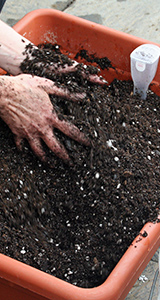 After you have your plan in place for this season's garden (or project/soil-less garden), you may learn something new. This is an example of when and how to address a curve-ball or unexpected bit of new information with your nature partner.
Why Gardeners Should Stop Using Peat, and What to Use Instead
[The New York Times, February 2, 2022 — You may be required to create an account to read this article.]
If you read that article and still think, "What's the big deal? I just have one small garden." then we suggest:
Does Peat Moss Have a Place in the Ecological Garden? [Natural Life Magazine]
Be a Change Maker with Nature [Perelandra]
 Now that you know, what do you do?
With this kind of information, it is important to turn to nature and say, "Here's what I just learned: ______(explain to nature what you learned and the dilemma it causes for you)______."
Then say, "In light of this, I need your help finding the best replacement for ___(using peat in my garden or for my seed starting)____."
This approach can be used with any aspect of your gardening. Fill in the blank with whatever soil, compost, fertilizer, other garden material or tool that is no longer available or that you no longer wish to use.
Ask nature to help you as you do your research and find options. Be sure to take those options back to nature. Read out loud to nature the details of the substitution possibilities you have found. (Give the specific variety, the ingredients and source.). Then use PKTT and test each one (or use your intuition if you're Gut Gardening). Confirm to nature the substitute you have tested to use: "Is this the replacement I am now to use?" [Test]
A Few More Things to Consider When Making Adjustments
There may be more than one option that is an equal substitute by nature's standards. And you may be mixing ingredients, in the case of something like a seed starter mix.

Be sure you follow your gut and any insights you are picking up. If a question pops into your head, hit the Start button* and ask your nature partner about it. Say it out loud. Be clear and straight-forward.
When you have questions, just ask the first one. Let the answer to that question lead you to the next question (if there is a next question).
Remember to thank your nature partner and hit the Stop button* when you've completed your meeting.
* For setting up and using the Start and Stop buttons, see the top of page 23 in The Perelandra Garden Workbook. (It's in the free excerpt here.)
Tell nature if you're confused or concerned by the information you're getting. For example: If nature is saying to use something you don't think is "environmental" — maybe you test to use treated timbers as borders of a garden area. Or perhaps you're a seed purist and you keep testing or being drawn to a non-organic seed, or a hybrid or commercially-developed seed/plant. In these situations, be honest with nature about your hesitations. But stay open to the possibility this is best for your garden for now, and for reasons you don't yet understand. The matter, means and action needed to create a balanced, healthy garden are nature's domain. And the purpose of this partnership is to get and act on nature's input.
The point is, let nature guide you when new choices and decisions have to be made. As our climate changes, our gardening options will change and we'll get new information about environmental impacts. That is exactly why this partnership with nature is essential now more than ever.
Remember, nature knows balance. And nature takes into consideration the broader environment plus your garden's DDP and you.
 Just learning about our gardening series?
Join us in this exciting partnership. And get help with questions like the ones above. Start here for the introduction to our series, then read along each week and join in on the parts that speak to you.
 Soil-less Gardeners
You can follow this same approach to address out-of-the-blue information that impacts parts of your soil-less garden project.